
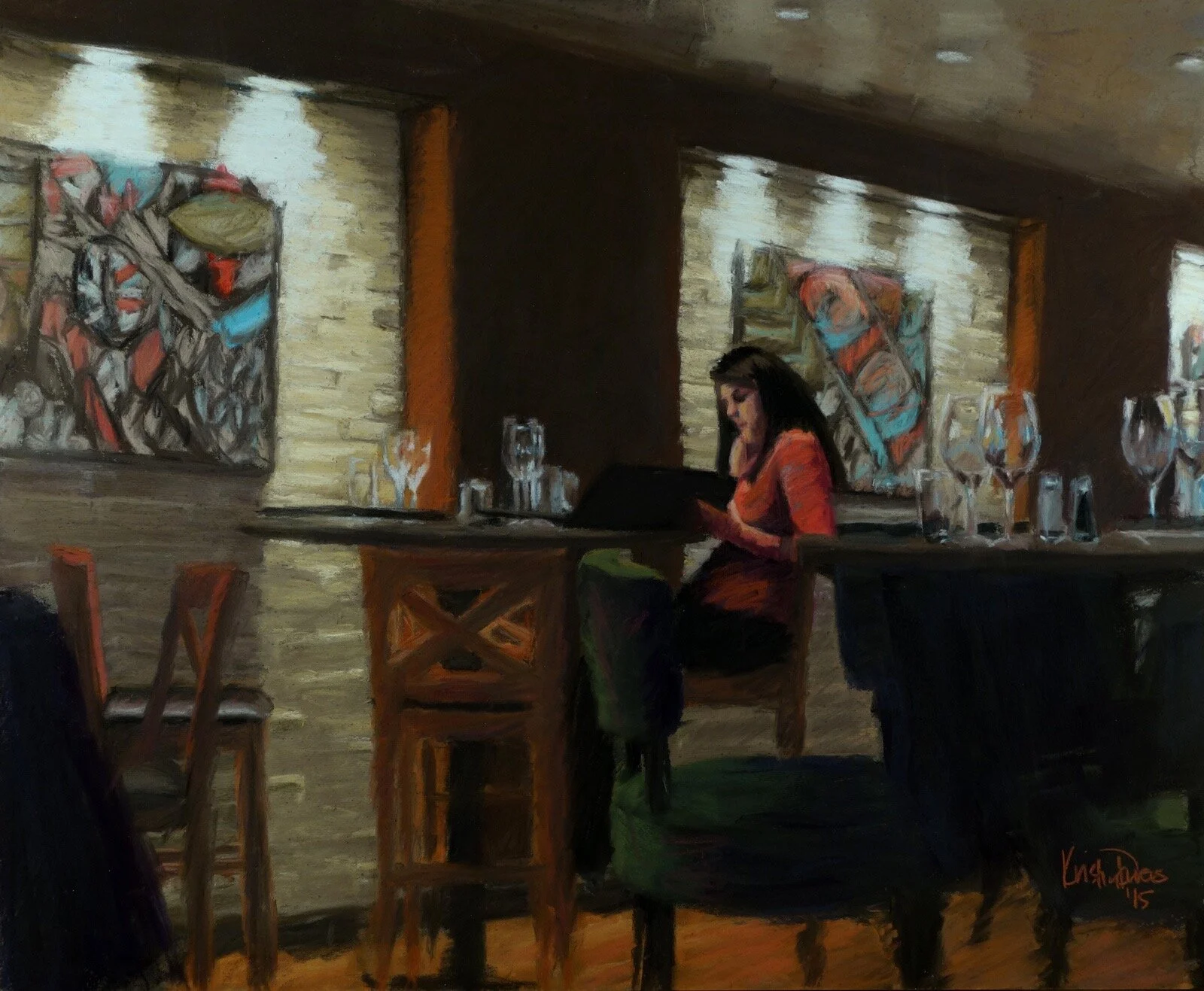
I am an artist, a pastel painter. You may have seen my work hanging in the Harrison Center. Of course, I’m an art lover, all kinds of art. When my three kids were growing up I encouraged them to explore as many types as they could. Our house was filled with their best efforts at ceramics, painting, drawing, photography, and playing musical instruments. Turn a corner in our home and you could end up in the middle of a dance rehearsal, a film set, or a discussion of proper grammar and good editing. They each ended up as professionals in at least one area of the arts. (Not musical instruments, though. Let’s just leave it at that.)
I am a patron of the arts. (And, I’m not talking about classes for my kids here.) I enjoy buying albums, books, and movies; I willingly purchase tickets to museums, dance performances, and concerts. There is something intensely special about buying an original piece of visual art that you love, however. The experience doesn’t compare with enjoying the arts in any other way. It’s not superior; it’s just different. There is a disparity between 2D, 3D visual arts and other types of art.
Visual art is unique among art forms. Other created works of art, from film to dance, from the written word to music to photography, are designed to be reproduced, replicated, or performed; the more reproduced the better. The interest of choreographers, authors, composers, filmmakers, and photographers is to have their work enjoyed, perhaps materials or tickets purchased, by as many people as possible. This is their intent. With visual art creations, the original piece of art holds the real (and perceived) value. This is the intent of the visual artist.
I expect some kickback on this …
You may be thinking, “What about the high value of original versions of manuscripts, or the actual author’s notes on a famous novel?” True. However, I would argue that this was never the initial intent of any artist. Just this summer, an anonymous buyer purchased the original manuscript of Don McLean’s 1971 epic hit American Pie for a cool $1.2 million. That’s a big piece of pie. McLean, now 70, reportedly said that he wanted top dollar for the manuscript to provide for his family. Ha! I’m sure that wasn’t his intent back in 1971 when he recorded it as the title song of his second album. His first album had really only succeeded at providing cover material for singers like Perry Como. McLean wanted to hear his own song on the radio.
“What about the high cost of prints, especially limited reproductions?” True. You can lay down quite a few dollars on a print. However, it would never compare to the cost of the original. My husband Lou and I laughed last year when Nu Couché, a painting by Amedeo Modigliani, was sold through Christie’s for $170.4 million. We laughed because we have a copy of that painting in our bedroom. We purchased it from artposters.com and probably paid about $17.04. It wasn’t signed by the artist. I didn’t even have to sign for it when it arrived in its cardboard box.